


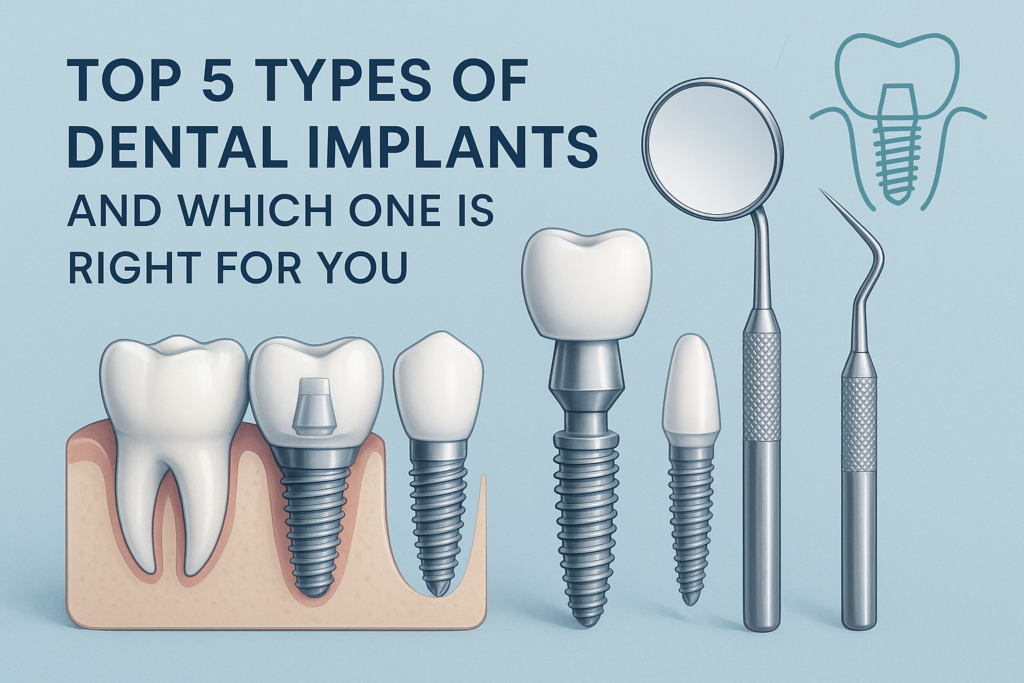
Losing a tooth can be a disheartening experience, impacting not just your smile but also your ability to chew, speak, and even your overall confidence. For many years, dentures and bridges were the primary solutions, but with advancements in modern dentistry, dental implants have emerged as the gold standard for tooth replacement. Offering unparalleled stability, aesthetics, and longevity, implants are a life-changing investment. But with various types available, how do you determine which one is right for you? This comprehensive guide will explore the top five types of dental implants, helping you understand their unique benefits and suitability for different situations.
Why Choose Dental Implants?
Before delving into the specific types, it’s worth reiterating why dental implants are often considered the superior choice. Unlike traditional bridges that rely on adjacent teeth for support or dentures that can slip and cause discomfort, implants are surgically placed into the jawbone. This integration, known as osseointegration, creates a strong, stable foundation for a crown, bridge, or even full-arch dentures. They prevent bone loss, maintain facial structure, and feel remarkably like natural teeth. When searching for the best dental implants, understanding the various options is crucial.
1. Endosteal Implants: The Most Common Choice
Endosteal implants are by far the most popular and widely used type of dental implant. They are typically made of titanium, a biocompatible material that readily fuses with bone.
- What they are: These implants are shaped like small screws, cylinders, or blades and are surgically placed directly into the jawbone. After placement, a healing period of several months allows for osseointegration. Once the implant has fused with the bone, an abutment is attached, and then the custom-made crown is placed on top.
- When they are used: Endosteal implants are suitable for most patients with healthy jawbone density. They can replace a single tooth, multiple teeth, or even support a full arch of prosthetic teeth.
- Benefits: High success rates, excellent stability, long-lasting, and feel very natural. They are often considered the best dental implants for straightforward tooth replacement.
- Considerations: Requires sufficient bone volume and density. If bone loss has occurred, a bone grafting procedure may be necessary prior to implant placement.
2. Subperiosteal Implants: An Alternative for Bone Loss
While less common today due to advancements in bone grafting, subperiosteal implants offer an alternative for patients who cannot undergo bone grafting or have insufficient bone height.
- What they are: Unlike endosteal implants, subperiosteal implants are not placed into the jawbone. Instead, they consist of a custom-made metal framework that sits on top of the jawbone, directly underneath the gum tissue. Posts extending from the framework protrude through the gum, to which the prosthetic teeth are attached.
- When they are used: Primarily for patients who have significant bone loss and are unable or unwilling to undergo bone grafting.
- Benefits: Avoids the need for bone grafting, potentially quicker treatment for some.
- Considerations: Lower success rates compared to endosteal implants, can be less stable, and may not last as long. They are generally not the first choice when seeking the best dental implants.
3. All-on-4® Dental Implants: Full Arch Restoration
For individuals missing an entire arch of teeth, or those facing widespread tooth extraction, All-on-4® offers a revolutionary solution.
- What they are: This technique involves strategically placing four dental implants in the jawbone, often at an angle, to support a full arch of fixed prosthetic teeth. The angled placement maximizes contact with existing bone, frequently eliminating the need for bone grafting, even in cases of moderate bone loss. In many cases, a temporary set of teeth can be attached on the same day as surgery, allowing patients to leave with a functional smile.
- When they are used: Ideal for patients who need to replace all teeth in the upper or lower jaw, or both. It’s an excellent alternative to traditional dentures.
- Benefits: Faster treatment time (often same-day teeth), fewer implants required, often avoids bone grafting, and provides a stable, fixed solution that feels and functions like natural teeth. It’s often touted as one of the best dental implants solutions for full arch rehabilitation.
- Considerations: Requires careful planning and surgical precision. While it offers immediate results, the final prosthetic is placed after a healing period.
4. Mini Dental Implants (MDIs): Smaller and Less Invasive
Mini dental implants are, as their name suggests, smaller in diameter than traditional endosteal implants.
- What they are: MDIs are typically about half the size of conventional implants, featuring a single-piece design with a ball-shaped head that protrudes from the jawbone. They are often used to stabilize lower dentures.
- When they are used: Primarily for stabilizing loose lower dentures, but can also be used for single tooth replacement in areas with limited space or for temporary tooth replacement. They are also an option for patients with less bone density who might not be candidates for traditional implants without grafting.
- Benefits: Less invasive procedure, quicker recovery time, often lower cost, and can be placed in areas with less bone.
- Considerations: Less stable than traditional implants for long-term single tooth replacement, primarily used for denture stabilization. While convenient, they may not be considered the best dental implants for all applications due to their smaller size and reduced stability for certain cases.
5. Zygomatic Implants: For Extreme Bone Loss in the Upper Jaw
Zygomatic implants represent a highly specialized approach for patients with severe bone loss in the upper jaw, making traditional implant placement impossible.
- What they are: These are exceptionally long implants that are anchored into the zygoma bone (cheekbone) rather than the maxilla (upper jawbone). Due to their length and placement, they bypass the need for extensive bone grafting in the upper jaw.
- When they are used: Reserved for patients with extreme atrophy of the upper jawbone, often due to long-term tooth loss, trauma, or certain medical conditions, where other implant options are not viable.
- Benefits: Provides a fixed solution for patients with severe upper jaw bone loss, avoiding complex and lengthy bone grafting procedures.
- Considerations: A more complex surgical procedure, requires a highly skilled and experienced oral surgeon, and often carries a higher cost.
Which One Is Right for You?
Choosing the best dental implants depends entirely on your individual oral health, bone density, number of missing teeth, and overall health. A thorough consultation with a qualified dental professional is essential. They will conduct a comprehensive examination, including dental X-rays and 3D scans (CBCT), to assess your bone structure, identify any underlying issues, and determine the most suitable implant type for your specific needs. They will discuss the pros and cons of each option, the treatment timeline, and the associated costs, ensuring you make an informed decision for a healthier, more confident smile.
Author Bio: A passionate advocate for oral health and a seasoned writer in the dental field, the author specializes in demystifying complex dental procedures and empowering readers with knowledge. With a background in health communications, they believe that understanding your treatment options is the first step towards a radiant and healthy smile. Their work focuses on providing clear, concise, and valuable insights into the latest advancements in dentistry.