Writing a thesis is arguably the most daunting milestone of a student’s academic journey. It is not just a long essay; it is a formal demonstration of your ability to conduct independent research, analyze complex data, and contribute original thought to your field. Yet, despite the high stakes, many students fall into predictable traps that can delay graduation or lead to significant point deductions.
According to a 2025 survey by the National Literacy Trust, approximately 33.5% of students express significant anxiety regarding grammar and structural errors in their formal writing, while nearly 35% admit to diving into writing without a structured plan. This lack of preparation often leads to “patchwriting”—a form of academic misconduct where sources are stitched together without sufficient original analysis.
To navigate these challenges, many scholars seek professional thesis help to ensure their research design and structural flow meet the rigorous standards of modern universities. Understanding these common pitfalls is the first step toward submitting a document that stands up to the scrutiny of an examination committee.
Top 5 Common Mistakes in Thesis Writing
1. A Vague or Overly Broad Research Question
The foundation of any successful thesis is a laser-focused research question. A common error is choosing a topic that is too “grand” for the scope of a master’s or doctoral project. For instance, attempting to analyze “The Impact of Climate Change on Global Economics” is a task for a multi-year institutional study, not a single student.
How to Avoid It: Use the FINER criteria (Feasible, Interesting, Novel, Ethical, and Relevant). Narrow your scope to a specific geographic region, a clear timeframe, or a particular demographic. A well-defined question makes the subsequent data collection manageable and the analysis much deeper.
2. Descriptive Rather Than Critical Literature Reviews
Many students treat the literature review as a “summary list,” merely reporting what Author A and Author B have said. However, examiners look for synthesis and critique. In 2026, academic integrity standards have shifted to emphasize “intellectual positioning”—meaning you must show how your work fills a specific “gap” in existing knowledge.
How to Avoid It: Organize your literature review thematically rather than chronologically. Compare different viewpoints, identify contradictions in previous research, and explain exactly why the existing literature is insufficient to answer your specific research question. If you find yourself overwhelmed by the sheer volume of reading, you might think, “I need someone to write my thesis for me,” but the real solution often lies in hiring a consultant to help you map out these critical connections.
3. Methodology Without Justification
A “Methodology” chapter that only lists the tools used (e.g., “I used a Likert scale survey”) is incomplete. The most frequent critique from supervisors is the lack of justification. You must explain why a qualitative approach was superior to a quantitative one for your specific goals.
How to Avoid It: Always link your methodological choices back to your research philosophy (Epistemology and Ontology). Explicitly state the limitations of your chosen method and how you mitigated potential biases.
4. Ignoring Institutional Formatting and Citation Rules
It may seem trivial, but formatting errors are the #1 cause of “minor corrections” that delay final approval. Whether it is APA 7th edition, Harvard, or MLA, inconsistency signals a lack of professionalism. Research indicates that up to 28% of students struggle specifically with applying consistent academic styles (Source: Research.com 2026 Education Trends).
How to Avoid It: Use citation management software (like Zotero or Mendeley) from day one. Download your university’s specific style guide and create a “master template” before you write a single word of your first draft.
5. Underestimating the Revision and Proofreading Phase
Rushing the final submission is a fatal error. A thesis requires multiple levels of editing: structural (logical flow), stylistic (academic tone), and technical (grammar/spelling). Data shows that students who engage in at least three rounds of revision score 15% higher on average than those who submit their first or second drafts.
How to Avoid It: Finish your draft at least three weeks before the deadline. This “cooling-off period” allows you to return to the text with fresh eyes, making it easier to spot logical gaps and repetitive phrasing.
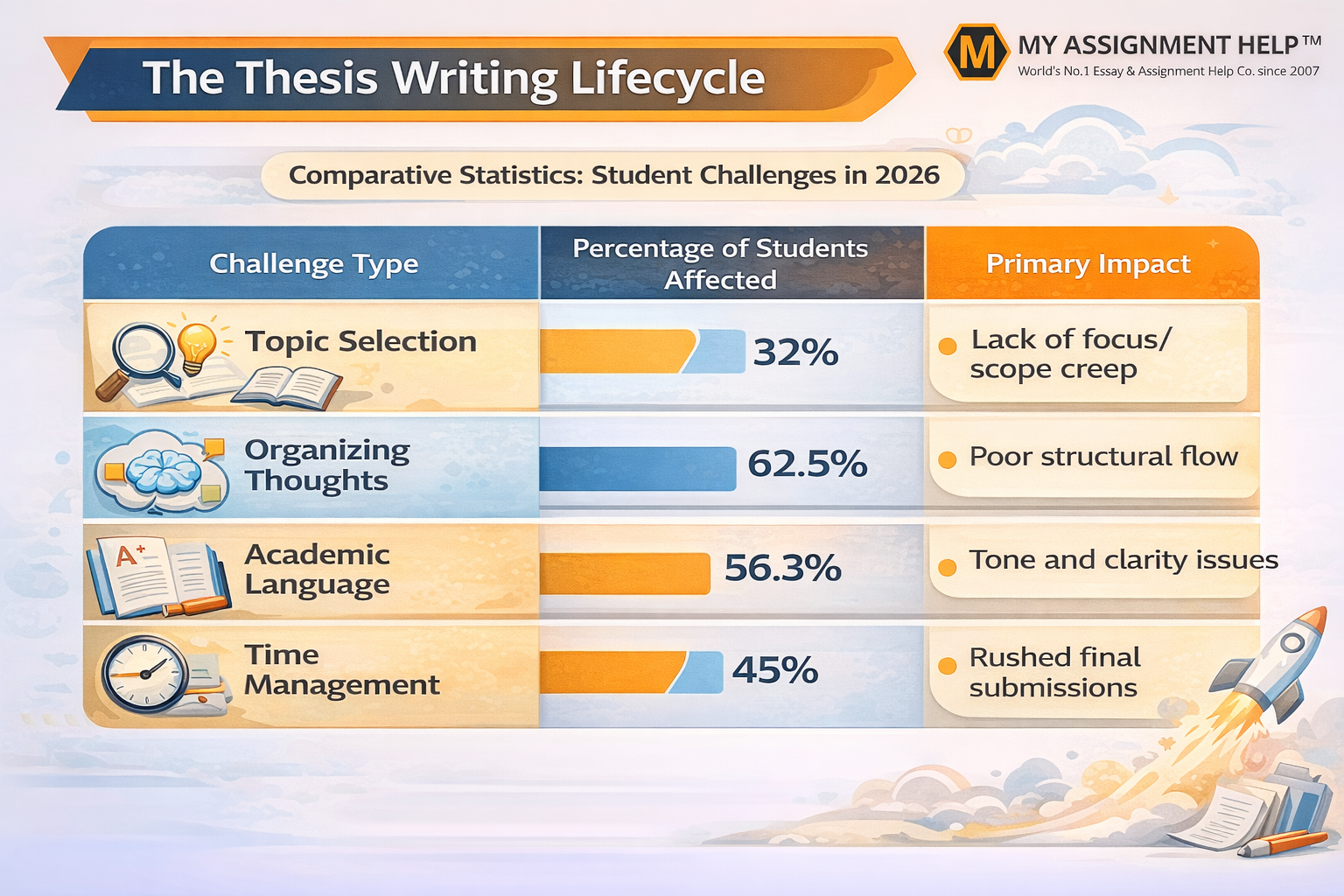
The Thesis Writing Lifecycle
FAQs
Q: Can I use AI to write my thesis?
Most universities in 2026 have strict AI-use policies. While AI can help with brainstorming or clarifying a sentence, using it to generate entire sections is considered “AI-assisted plagiarism” (Patchwriting 2.0) and can lead to disqualification.
Q: What is the ideal length for a Master’s thesis?
This varies by department, but typically ranges between 12,000 and 20,000 words. Always check your specific department handbook for word count constraints.
Q: How do I know if my research question is “novel”?
A “novel” question doesn’t have to reinvent the wheel. It can involve applying an existing theory to a new context, using a different methodology on an old problem, or updating data that is more than five years old.
References
- Research.com (2026). 50 Current Student Stress Statistics: Data, Analysis & Predictions.
- National Literacy Trust (2025). Children and young people’s writing in school report.
- Turnitin (2025). New and emerging trends in academic misconduct.
- Journal of Environmental Sciences (2025). Challenges in Writing a Research Paper: A Study of Undergraduate Experiences.
Author Bio
Dr. Aris Thorne is a senior academic consultant at MyAssignmentHelp and content strategist with over 12 years of experience in higher education. Specialized in research methodology and postgraduate mentorship, Dr. Thorne has helped thousands of students navigate the complexities of dissertation writing and academic integrity.
Email indiaclery@gmail.com with the article link and details.